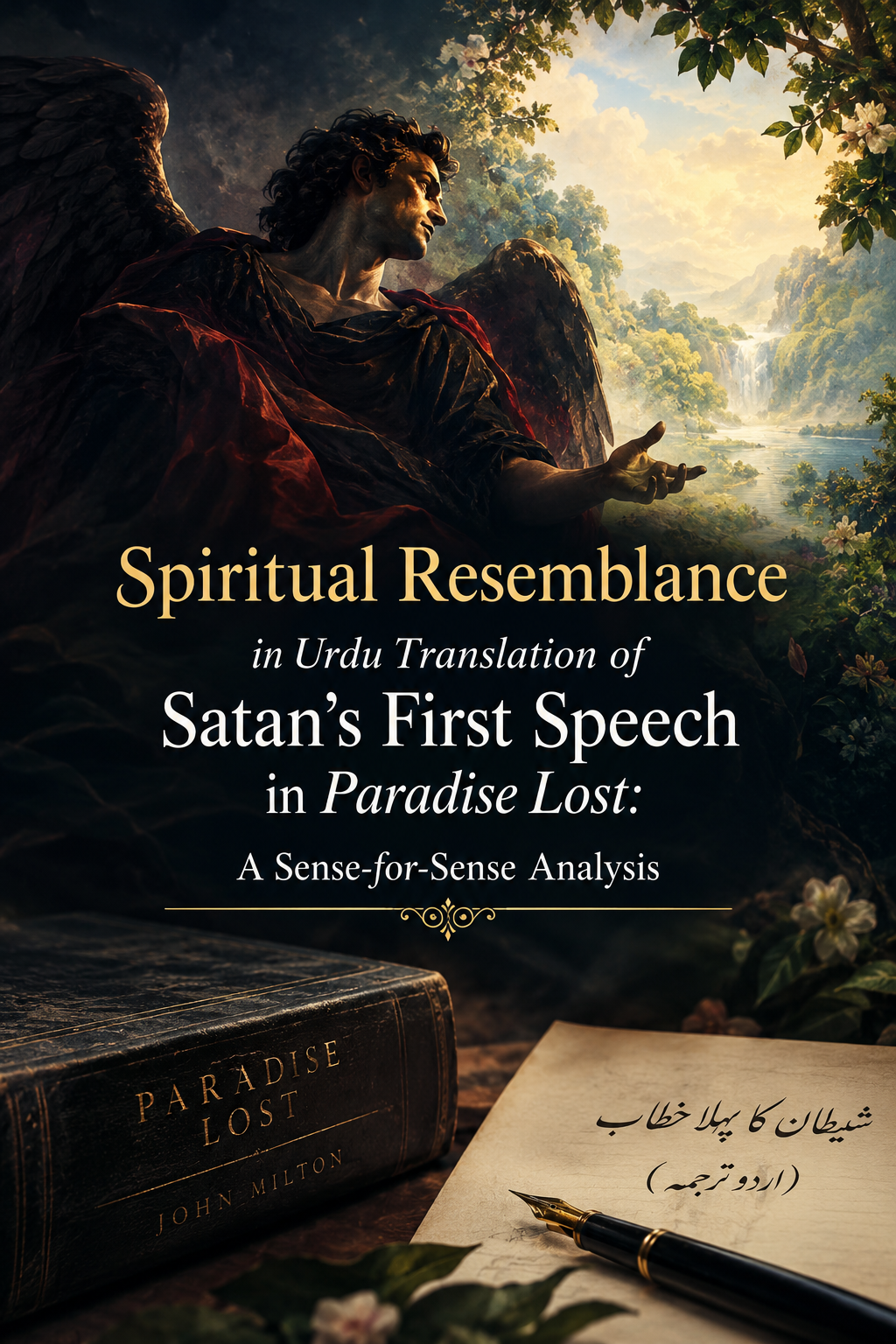
Spiritual Resemblance in Urdu Translation of Satan’s First Speech in Paradise Lost: A Sense-for-Sense Analysis
DOI:
https://doi.org/10.63056/jllsa.2.10.2026.391Keywords:
Spiritual resemblance, Urdu translation, satan’s first speech, sense for sense, comparative analysisAbstract
This study examines the Urdu translation of Satan’s first speech in Paradise Lost by Wasim Khan Niazi using Fu Lei’s theory of spiritual resemblance, which prioritizes artistic and emotional depth over literal accuracy. Paradise Lost is famous for its rhetorical brilliance, philosophical depth, and poetic grandeur. Through a comparative textual analysis, this research evaluates whether the Urdu translation captures the spirit, rhetorical intensity, and ideological differences of the original text. The findings reveal that while the translation remains linguistically accurate, but it fails to preserve Milton’s stylistic grandeur, persuasive strategies, and emotional depth. This suggests that the translation aligns more with formal equivalence rather than Fu Lei’s concept of artistic fidelity. By applying spiritual resemblance theory, this study highlights the challenges of translating classical English literature into Urdu. The research plays a role in translation studies by demonstrating how literary translations should be more focused on spirit of the original work.
Downloads
Published
How to Cite
Issue
Section
License
Copyright (c) 2026 Fiza Ijaz, Dr. Amna Arshad, Rimsha Zubair

This work is licensed under a Creative Commons Attribution 4.0 International License.