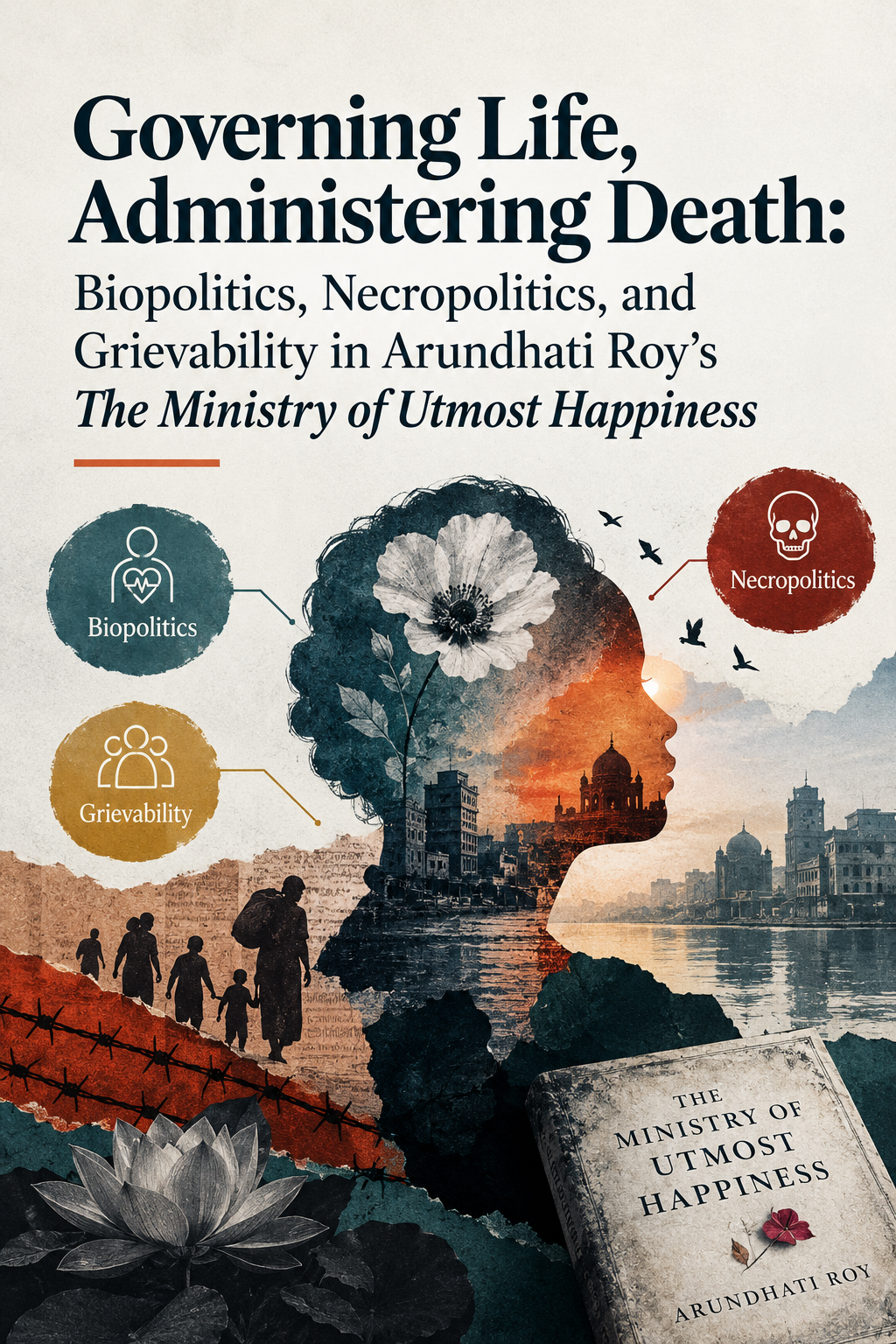
Governing Life, Administering Death: Biopolitics, Necropolitics, and Grievability in Arundhati Roy’s the Ministry of Utmost Happiness
DOI:
https://doi.org/10.63056/jllsa.2.10.2026.392Keywords:
The Ministry of Utmost Happiness, biopolitics, necropolitics, grievability, state sovereignty, postcolonial literature, Arundhati RoyAbstract
The Ministry of Utmost Happiness (2017) by Arundhati Roy is a significant work of postcolonial fiction that examines the relationship between state sovereignty and disposable lives in contemporary India. This paper argues that Roy's novel operates as a sustained critique of biopolitical governance, necropolitical violence and the unequal distribution of grievability. Michel Foucault's (1978) concept of biopolitics, Achille Mbembe's (2003) theory of necropolitics and Judith Butler's (2004, 2009) framework of grievability are applied through Catherine Belsey's (2005) method of textual analysis. The study shows how Anjum's exclusion from institutional citizenship enacts biopolitical normalisation; how Kashmir and Bastar function as Mbembe's death-worlds; and how Roy's treatment of mourning challenges the state's power to determine which lives are grievable. Moreover, the novel's counter-archival form, read through Sara Ahmed's (2004) affective economies, produces subaltern counter-publics that resist the nationalist narrative. The paper demonstrates that Roy's text combines political theory, counter-archival narrative form, and affective solidarity to confront the Indian state's management of marginalised communities. Close reading of the novel is supplemented by Roy's non-fiction essays, which serve as authorial commentary on the political contexts the fiction depicts.
Downloads
Published
How to Cite
Issue
Section
License
Copyright (c) 2026 Rizwan Safdar, Asfa Muqaddas, Sayyed Mudassir Shah

This work is licensed under a Creative Commons Attribution 4.0 International License.