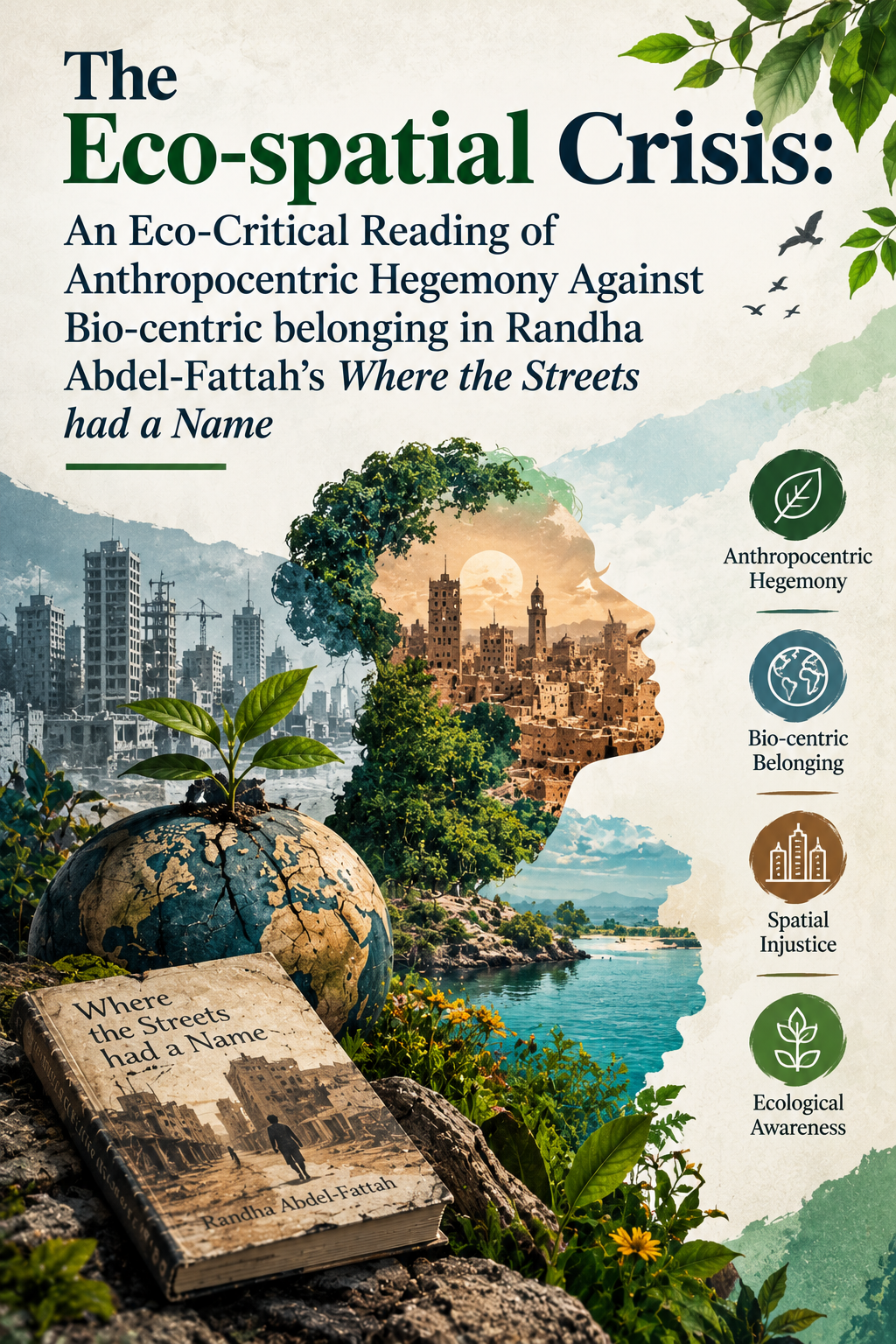
The Eco-spatial Crisis: An Eco-Critical Reading of Anthropocentric Hegemony Against Bio-centric belonging in Randha Abdel-Fattah’s Where the Streets had a Name
DOI:
https://doi.org/10.63056/jllsa.2.7.2026.395Keywords:
Biological Resistance, Bio-centric, Anthropocentric, Environmental Imagination, LandscapeAbstract
Using the theoretical framework of Lawrence Buell's The Environmental Imagination, this study examines the eco-spatial crises shown in Randa Abdel-Fattah's postcolonial novel Where the Streets Had a Name. This article explores the West Bank's physical landscape as an active, contested site of environmental pain and resistance, going beyond traditional geopolitical and sociopolitical readings. It establishes a contrast between an indigenous bio-centric belonging and the anthropocentric hegemony of the state apparatus, which uses concrete infrastructure like watch towers, armed checkpoints, and imperial maps to divide and monetize the natural environment. The study examines how the nonhuman environment demonstrates material agency by using Buell's criteria for an ecologically oriented text. It shows that the geopolitical border functions more as a mechanism of systematic ecological degradation than as a simple legal division. In the end, the story stimulates an environmental imagination that reclaims the "living land" over the "legal land" through the protagonist Hayaat's quest to retrieve ancestral soil from Jerusalem in a hummus jar. The study comes to the conclusion that, despite structural containment, this bio-centric attachment functions as a potent kind of ecological resistance that both physically and psychologically subverts colonial cartography, maintaining the organic human-land equation.
Downloads
Published
How to Cite
Issue
Section
License
Copyright (c) 2026 Zoreen Sohail, Dr. Saima Bashir

This work is licensed under a Creative Commons Attribution 4.0 International License.