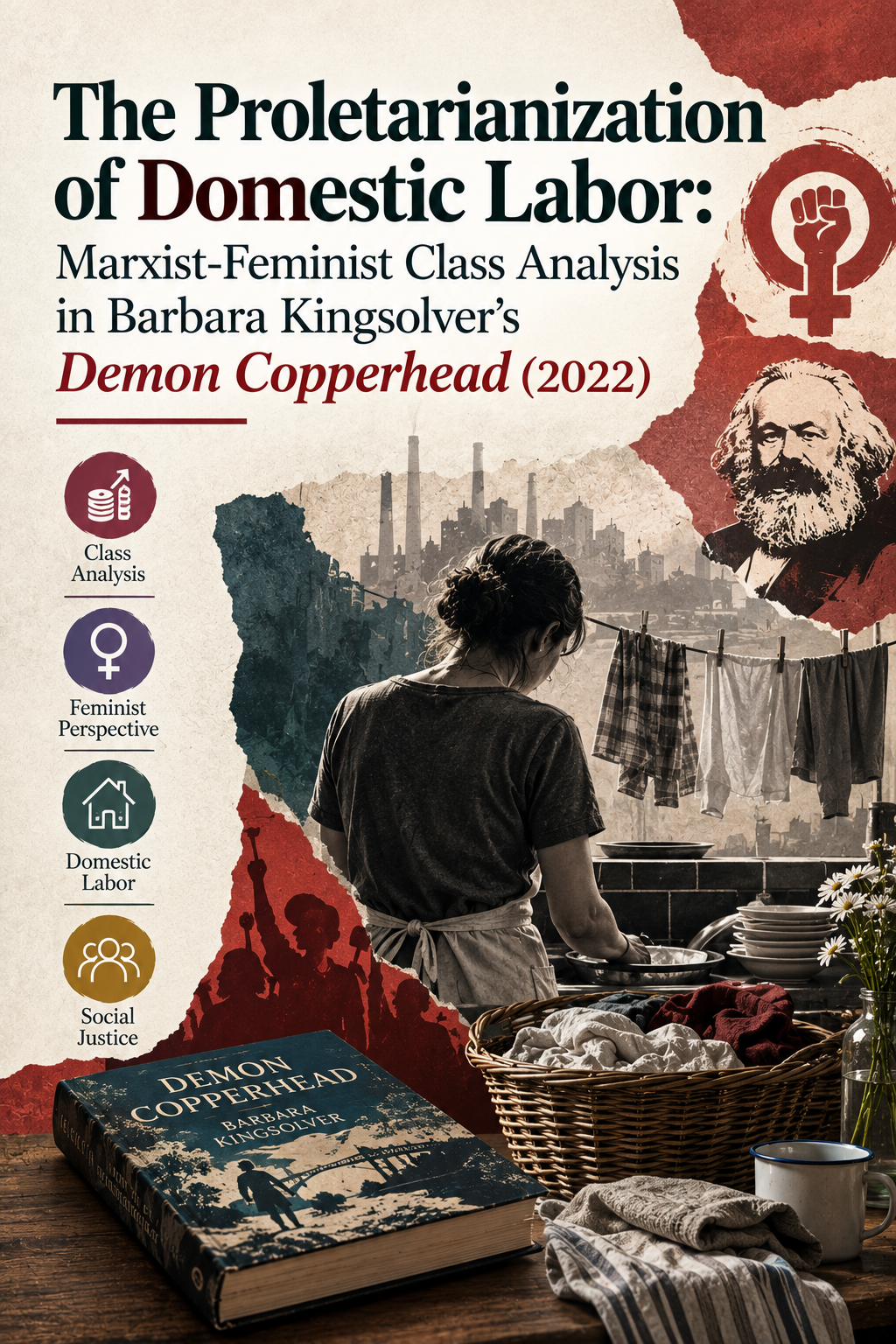
The Proletarianization of Domestic Labor: Marxist-Feminist Class Analysis in Barbara Kingsolver’s Demon Copperhead (2022)
DOI:
https://doi.org/10.63056/jllsa.2.10.2026.396Keywords:
Marxist feminism, social reproduction, domestic labor, Demon Copperhead, Appalachian literature, foster care, class struggleAbstract
This paper examines the depiction of domestic and caregiving work in Barbara Kingsolver’s Demon Copperhead (2022) through a Marxist-feminist lens. Drawing largely on Silvia Federici's concept of reproductive labor and supported by social reproduction theory, the study examines the economic undervaluation of unpaid and underpaid care work that sustains individuals, families, and communities. The paper employs a qualitative close textual analysis to examine the experiences of caring for Demon by his mother, Mrs. Peggot, Aunt June, Mrs. McCobb, Mattie Kate, and Dori. The analysis shows that the novel depicts domestic labor as a form of proletarianized work, often taken without remuneration or acknowledgment. The foster care system is another example of the commercialization of caring, because state payments put a finite price on the large amount of labor needed to nurture and support children. The study also reveals the disproportionate burden of domestic work borne by women and children, especially in the economically disadvantaged communities of Appalachia. Moreover, the novel links to other forms of economic exploitation linked to poverty, precarious jobs, and the opioid industry, which are related to the exploitation of caregiving labour. The paper contends that Demon Copperhead offers a sustained Marxist-feminist critique of capitalism's reliance on invisible care work and exposes the class and gender inequalities embedded in systems of family, foster care, and social reproduction.
Downloads
Published
How to Cite
Issue
Section
License
Copyright (c) 2026 Saba Hassan, Dr. Rizwana Iqbal

This work is licensed under a Creative Commons Attribution 4.0 International License.