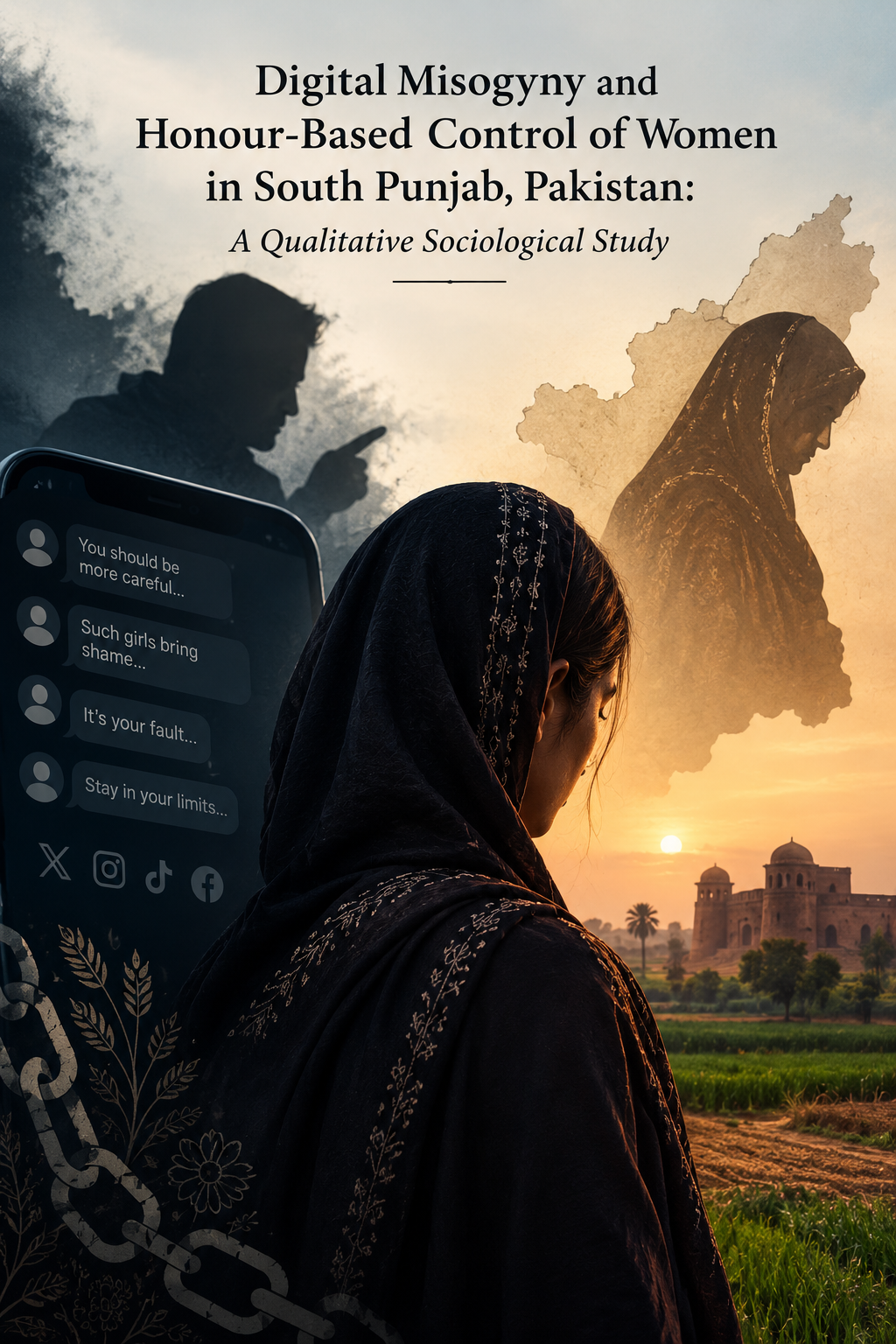
Digital Misogyny and Honour-Based Control of Women in South Punjab, Pakistan: A Qualitative Sociological Study
DOI:
https://doi.org/10.63056/jllsa.2.10.2026.400Keywords:
Digital misogyny, honour-based violence, technology-facilitated gender-based violence, patriarchy, stigma, symbolic violence, South Punjab, PakistanAbstract
Pakistan’s rapid digital expansion has widened women’s access to online communication while opening new channels of patriarchal surveillance. This study examines how digital misogyny intersects with honour-based control of women in South Punjab, a region shaped by kinship, biradari networks and collective notions of family honour (izzat). It draws on in-depth, semi-structured interviews with 15 women who had experienced digital harassment and honour-related threats. It also draws on five key informant interviews with legal practitioners, activists and community representatives. Participants were recruited through purposive and snowball sampling across Multan, Bahawalpur, Layyah, Bhakkar and Mianwali. The data were analysed using reflexive thematic analysis informed by feminist theory, Goffman’s theory of stigma and Bourdieu’s concept of symbolic violence. Women reported unwanted messages, impersonation through fake accounts, cyberstalking, blackmail and image misuse, often by men they already knew. The findings show that digital misogyny is not a separate online problem. It extends existing patriarchal regulation of women’s visibility, mobility and conduct. Harassment became an honour crisis once digital traces were circulated and morally reinterpreted, regardless of their truth. Families typically responded by confiscating phones, increasing monitoring and restricting mobility, rather than confronting perpetrators. Women coped through blocking, self-censorship, reduced visibility, alternative accounts and strategic silence, which can be read as negotiated agency. Distrust of institutions, fear of exposure and victim-blaming meant few women reached formal legal channels, and informal family-level settlement was preferred. The study proposes the “digital–honour nexus” to explain how online acts become socially consequential through kinship-based moral evaluation. It argues for culturally grounded, honour-sensitive policy responses.
Downloads
Published
How to Cite
Issue
Section
License
Copyright (c) 2026 Bedar Bakht Khan, Dr. Ayesha Chaudhary, Dr. Babak Mahmood, Zarfshan Tariq

This work is licensed under a Creative Commons Attribution 4.0 International License.