Dependent and Close Attachment Styles and Phubbing Behavior in Adults: The Mediating Role of Fear of Missing Out
DOI:
https://doi.org/10.63056/jllsa.2.10.2026.404Keywords:
Dependent Attachment Style, Close Attachment Style, Fear of Missing Out, Phubbing Behavior, MediationAbstract
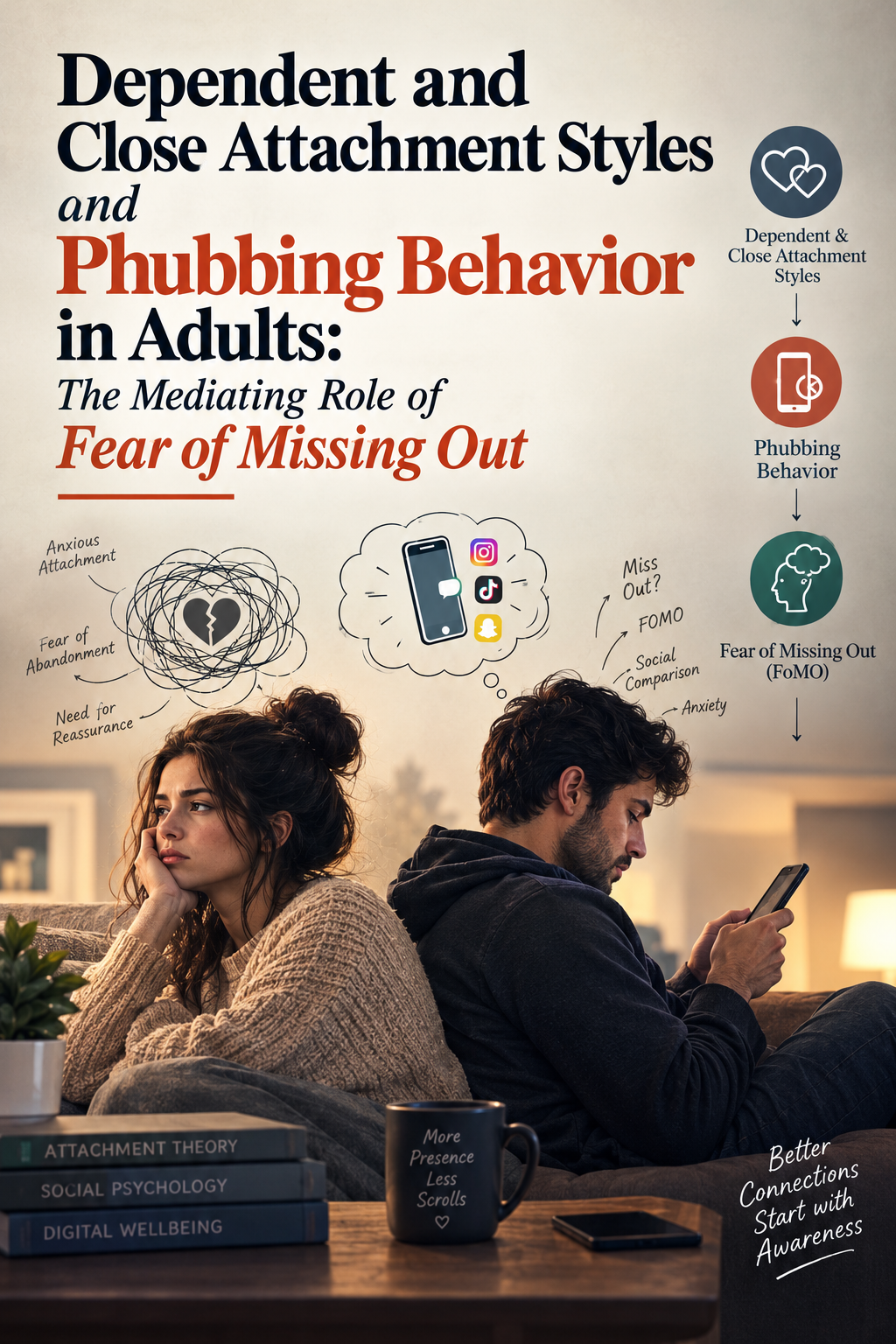
Adult attachment is the way that people approach attachment and intimacy and can impact the way they engage with their mobile phone in social contexts. The present study explored dependent and close attachment with phubbing behavior and investigated the mediation of fear of missing out (FOMO). A cross sectional correlational design was employed. The Revised Adult Attachment Scale Close Relationship Version, Fear of Missing out Scale and Phubbing Scale were completed by a convenience sample of 304 university students (152 male and 152 female) from Faisalabad, Pakistan. Pearson correlation, hierarchical multiple regression, and mediation analysis (PROCESS Model 4; 5,000 bootstrap samples) were used to analyze the data. Dependent attachment correlated positively with FOMO (r = .16) and phubbing (r = .20), while close attachment correlated with FOMO (r = .17) but not with phubbing (r = .10, p > .05). In a hierarchical regression controlling for anxious attachment, only dependent attachment and FOMO were significant predictors in the final model, which explained 39% of the variance in phubbing. FOMO partially mediated the relationship between dependent attachment and phubbing (indirect effect = .25, 95% CI [.07, .44]) and was the only pathway linking close attachment to phubbing (indirect effect = .27, 95% CI [.10, .46]; direct effect = −.01, ns). Findings show that FOMO is a pathway between attachment tendencies and relational tendencies with the phone and phubbing, and that FOMO could be a potential target for interventions targeting phubbing.
Downloads
Published
How to Cite
Issue
Section
License
Copyright (c) 2026 Farah Muqaddas, Laiba Sehar, Zunaira Sharafat, Eman Fatima, Bushra Rafique

This work is licensed under a Creative Commons Attribution 4.0 International License.