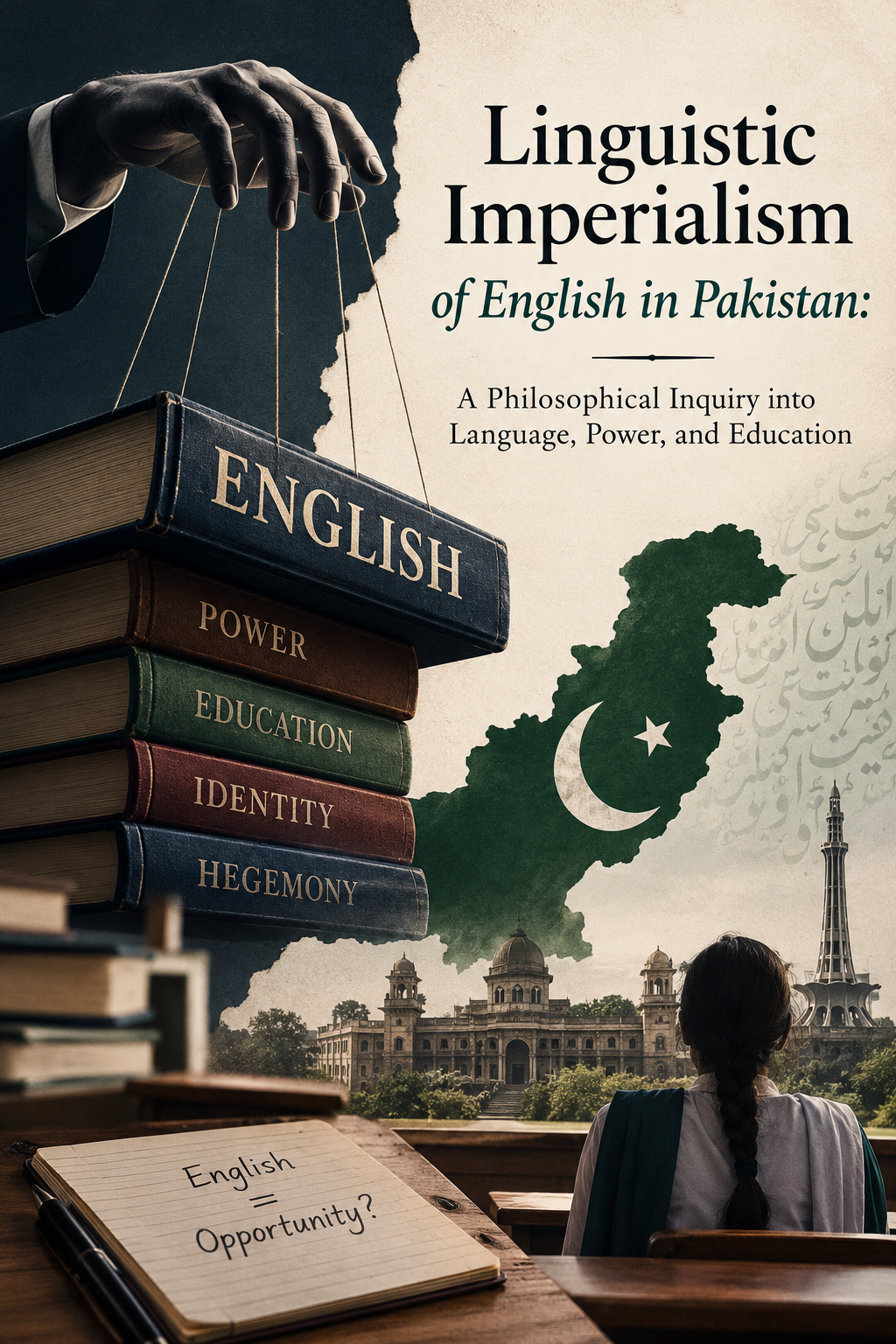
Linguistic Imperialism of English in Pakistan: A Philosophical Inquiry into Language, Power, and Education
DOI:
https://doi.org/10.63056/jllsa.2.6.2026.406Keywords:
Linguistic Imperialism, Language and Power in Education, Postcolonial Language Policy, Linguistic Capital, Epistemic InjusticeAbstract
Critical and postcolonial research has examined how language connects to power dynamics which operate in educational systems since its inception. The research demonstrates how English dominates Pakistan's educational framework through linguistic imperialism which asserts that educational institutions prioritize English to establish social hierarchies and control knowledge while maintaining political dominance. The research explores English use as both an educational advancement tool and an elite identity marker through its study of Pakistan's postcolonial history. The analysis utilizes Robert Phillipson's linguistic imperialism theory which views English global expansion as a colonial power extension (Phillipson, 1992) and Pierre Bourdieu's linguistic capital concept which explains how people use their language skills to gain social prestige Bourdieu (1991). The article investigates how educational institutions maintain epistemic injustice and indigenous language oppression through their language policies and educational methods by using postcolonial critical educational perspectives which include Ngũgĩ wa Thiong'o's (1986) research and Alastair Pennycook's (1998) research. The use critical language policy research is used to explore how language selection by institutions creates barriers to educational access and controls educational governance systems (Tollefson, 1991; Canagarajah, 1999). Through its investigation of Pakistan's educational policies and institutional language practices and sociocultural discourses the research shows how English language dominance creates class barriers which control how educational institutions create and recognize knowledge. The global academic and economic opportunities which English provides restrict local language development through its imperial status which leads to diminished linguistic variation. The article advocates for a language policy reassessment through philosophical research which should create educational language policies that promote linguistic inclusiveness while allowing schools to embrace worldwide knowledge with local cultural knowledge and understanding of different thinking styles.
Downloads
Published
How to Cite
Issue
Section
License
Copyright (c) 2026 Dr. Saima Jamshaid, Afifa Saleem, Aqsa Rani

This work is licensed under a Creative Commons Attribution 4.0 International License.