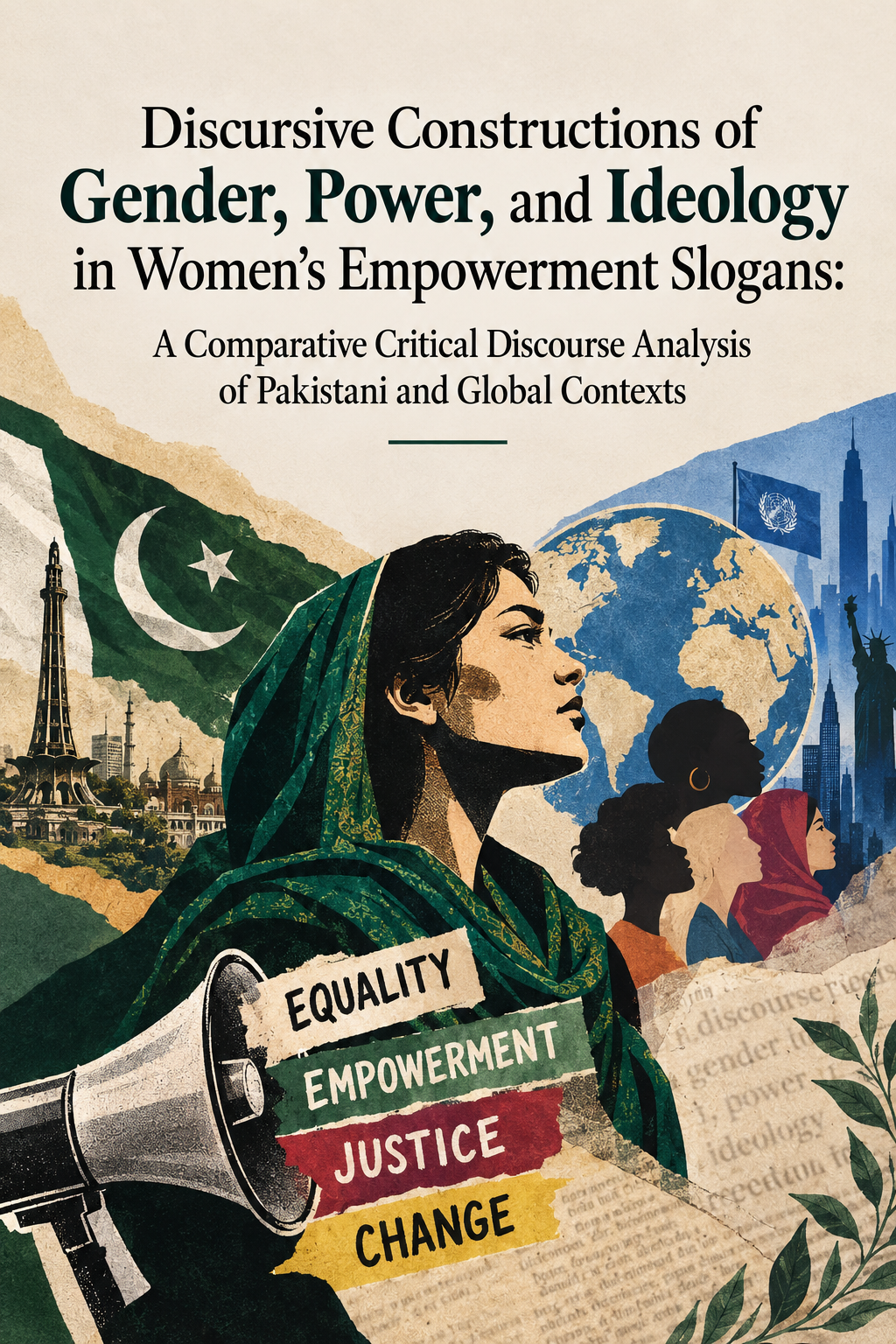
Discursive Constructions of Gender, Power, and Ideology in Women’s Empowerment Slogans: A Comparative Critical Discourse Analysis of Pakistani and Global Contexts
DOI:
https://doi.org/10.63056/jllsa.2.10.2026.410Keywords:
Fairclough's Three-D Model, feminist discourse, women's empowerment slogans, gender ideology, power relations, cross-cultural discourseAbstract
Slogans for women’s empowerment have served as strong discursive resources for constructing and contesting gender, power and ideology across sociocultural contexts. There is a lot of research on feminist speech but there is a lack of comparative studies on women’s empowerment slogans in Pakistan and internationally. Therefore, the present study fills this void and comparatively analyzes the representation of gender, power and ideology in the Pakistani and international women empowerment slogans through the lens of Fairclough’s (1995) Three-Dimensional Model of Critical Discourse Analysis. The research employed a qualitative research approach and used a purposively selected corpus of 20 slogans, containing 10 Pakistani chants from Aurat March and 10 overseas slogans from worldwide feminist initiatives. The data show that Pakistani slogans use colloquial, metaphorical and resistance-based language based on lived experiences of patriarchy, while international slogans use abstract, rights-based and institutional rhetoric centered on equality, empowerment and inclusion. Both organizations, despite the variations, question patriarchal ideals and call for gender justice. The work makes a contribution to feminist Critical Discourse Analysis by demonstrating the local and global mediation of gender, power and ideology through discourse. In future, feminist discourse in multilingual and multimodal can be studied in various cultural contexts.
Downloads
Published
How to Cite
Issue
Section
License
Copyright (c) 2026 Ayesha Ali, Zukhruf Shaukat, Aisha Saleem

This work is licensed under a Creative Commons Attribution 4.0 International License.