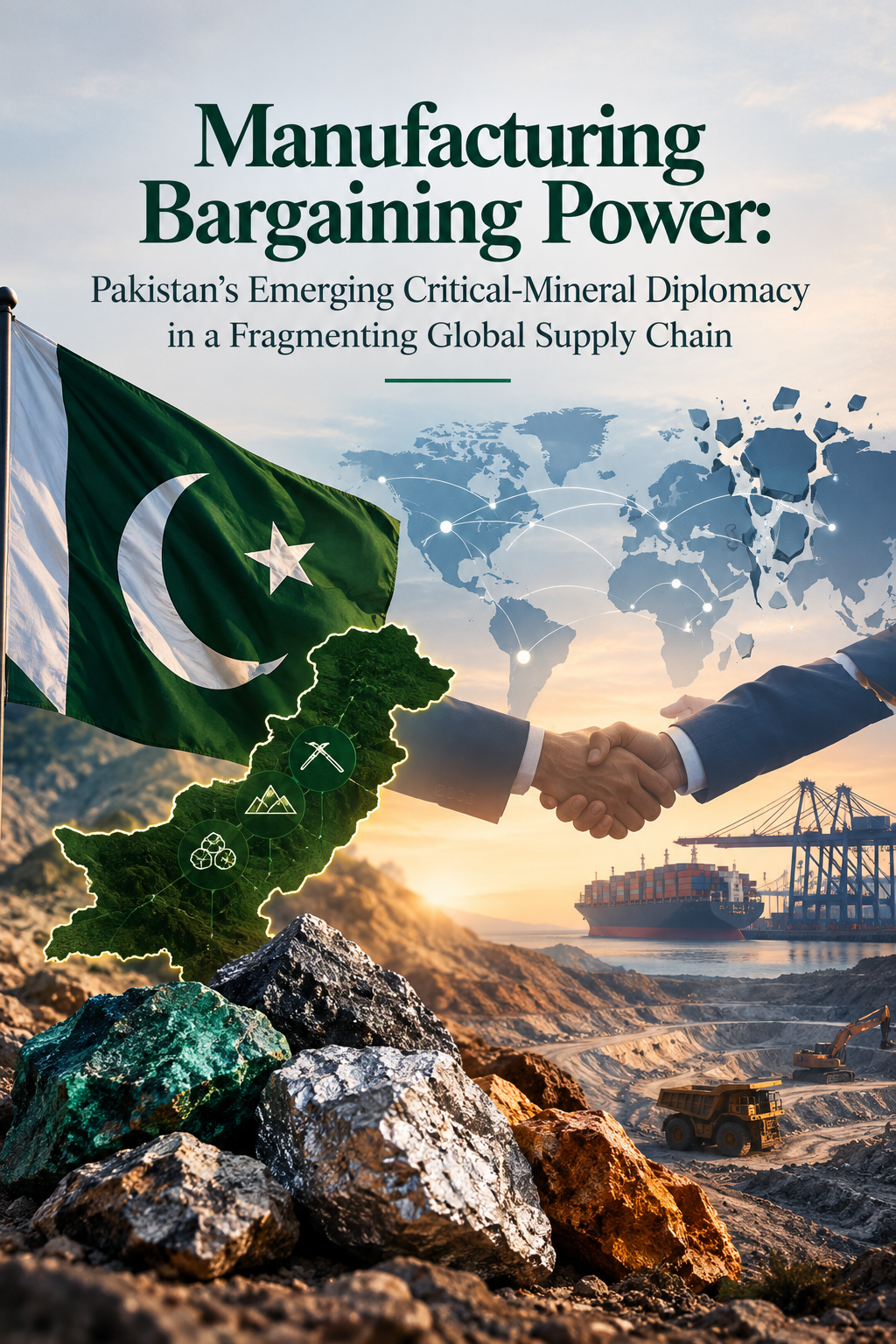
Manufacturing Bargaining Power: Pakistan’s Emerging Critical-Mineral Diplomacy in a Fragmenting Global Supply Chain
DOI:
https://doi.org/10.63056/jllsa.2.10.2026.411Keywords:
Pakistan, critical minerals, rare earths, mineral diplomacy, bargaining power, supply chains, geoeconomics, China, United States, developing statesAbstract
The intensifying geopolitical competition over critical minerals is restructuring the relationship between natural resources and international power. Existing scholarship largely explains this transformation through resource control, supply-chain dominance, or the strategic competition of major powers. Less attention has been given to resource-endowed developing states that possess geological potential but lack the industrial capacity necessary to exercise conventional resource power. This article examines Pakistan as a theoretically revealing case. It argues that Pakistan's emerging critical-mineral diplomacy is best understood not as the exercise of resource power, but as an attempt to manufacture bargaining power through prospective supply-chain positioning. Pakistan seeks to convert mineral potential into international relevance by attracting competing external investors, technological partnerships and downstream-processing opportunities. The article develops a conceptual framework of prospective bargaining power, in which diplomatic value emerges through the interaction of resource potential, external demand, investor competition and domestic conversion capacity. Using qualitative analysis of Pakistani policy documents, U.S. and Chinese policy material, official statements and elite-interview evidence, the study demonstrates that Pakistan occupies an intermediate position between resource possession and resource power. Its mineral diplomacy can increase bargaining opportunities even before commercially significant production is established, but only where Pakistan can maintain credible alternatives among external partners and strengthen domestic control over value-chain development. The article contributes to debates on critical-mineral geopolitics, geoeconomic statecraft and developing-state agency by showing how a state can seek to construct rather than merely possess bargaining power in fragmented global supply chains.
Downloads
Published
How to Cite
Issue
Section
License
Copyright (c) 2026 Mohsin Mahmood

This work is licensed under a Creative Commons Attribution 4.0 International License.