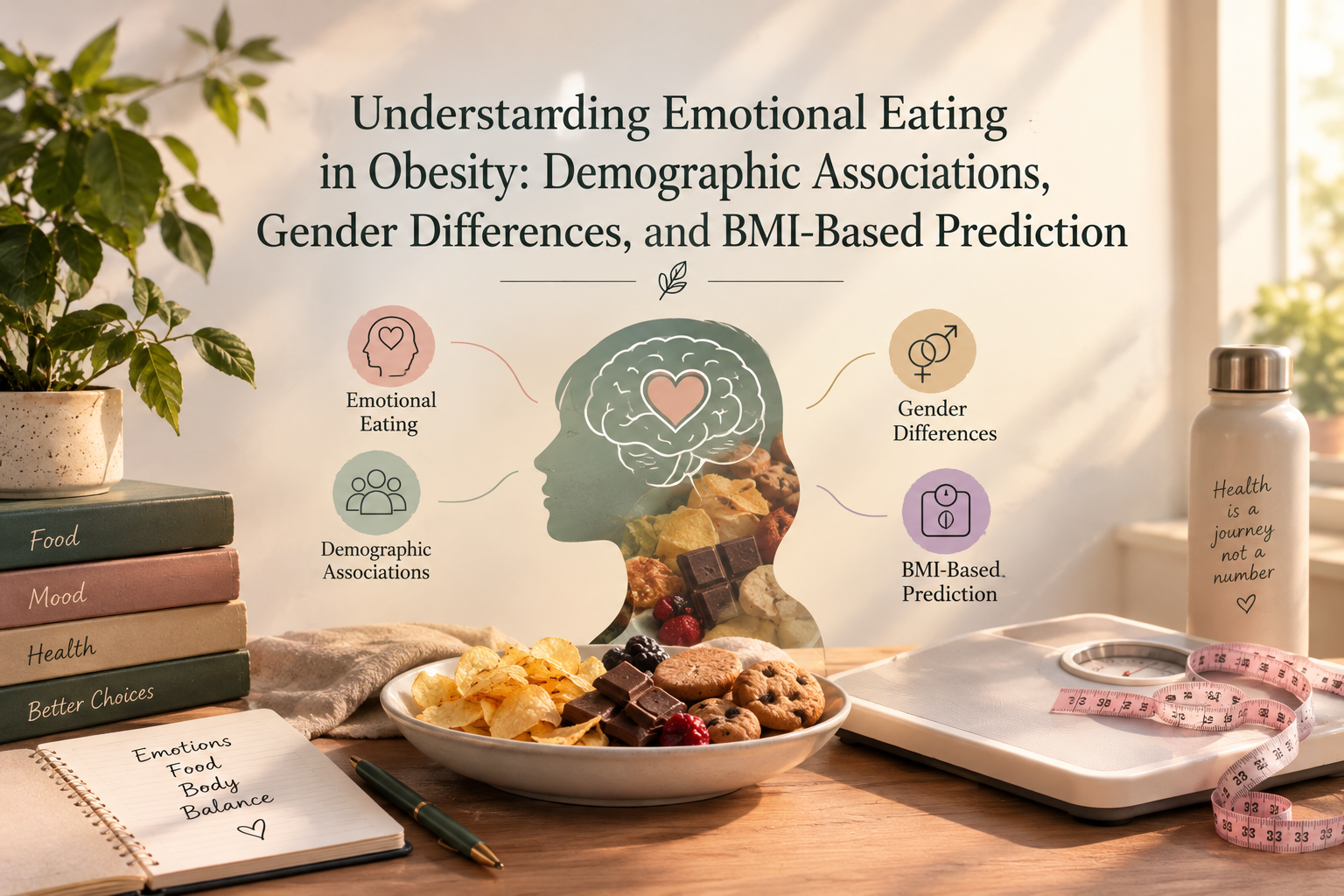
Understanding Emotional Eating in Obesity: Demographic Associations, Gender Differences, and BMI-Based Prediction
DOI:
https://doi.org/10.63056/jllsa.2.10.2026.421Keywords:
Emotional eating, body mass index, obesity, gender differences, neural networkAbstract
The term emotional eating refers to eating behavior due to emotional state and not physiological hunger. In many cases, obesity patients tend to indulge in emotional eating. This cross-sectional study investigates whether body mass index is a predictor of emotional eating in obese individuals, if there are any differences between male and female participants in relation to their emotional eating behavior, and also assesses the relative effect of gender, age, and body mass index on the emotional eating behavior through a neural network. Purposive sampling was used to select 250 obese participants (125 male and 125 females) with a body mass index above 30 kg/m2. BMI significantly and positively predicted emotional eating, B = 0.339, β = .176, t = 2.81, p = .005, but explained only 3.1% of the variance, F(1, 248) = 7.90, p = .005. Women (M = 27.02, SD = 2.45) reported significantly higher emotional eating than men (M = 23.06, SD = 5.45), t(172.39) = −7.43, p < .001, 95% CI [−5.02, −2.91], a large difference (d ≈ 0.94). In the neural network, gender was the most important predictor (normalized importance = 100%), followed by BMI (24.1%) and age (4.7%), although predictive accuracy was modest (relative error = .818 for training and .827 for testing). Findings suggest that, within an obese sample, gender distinguishes emotional eating more strongly than BMI does. Weight-management programs may therefore benefit from gender-sensitive screening and support for emotional eating.
Downloads
Published
How to Cite
Issue
Section
License
Copyright (c) 2026 Samra Rani, Nimra Shahzadi, Hamyle Javaid, Iram Naz

This work is licensed under a Creative Commons Attribution 4.0 International License.