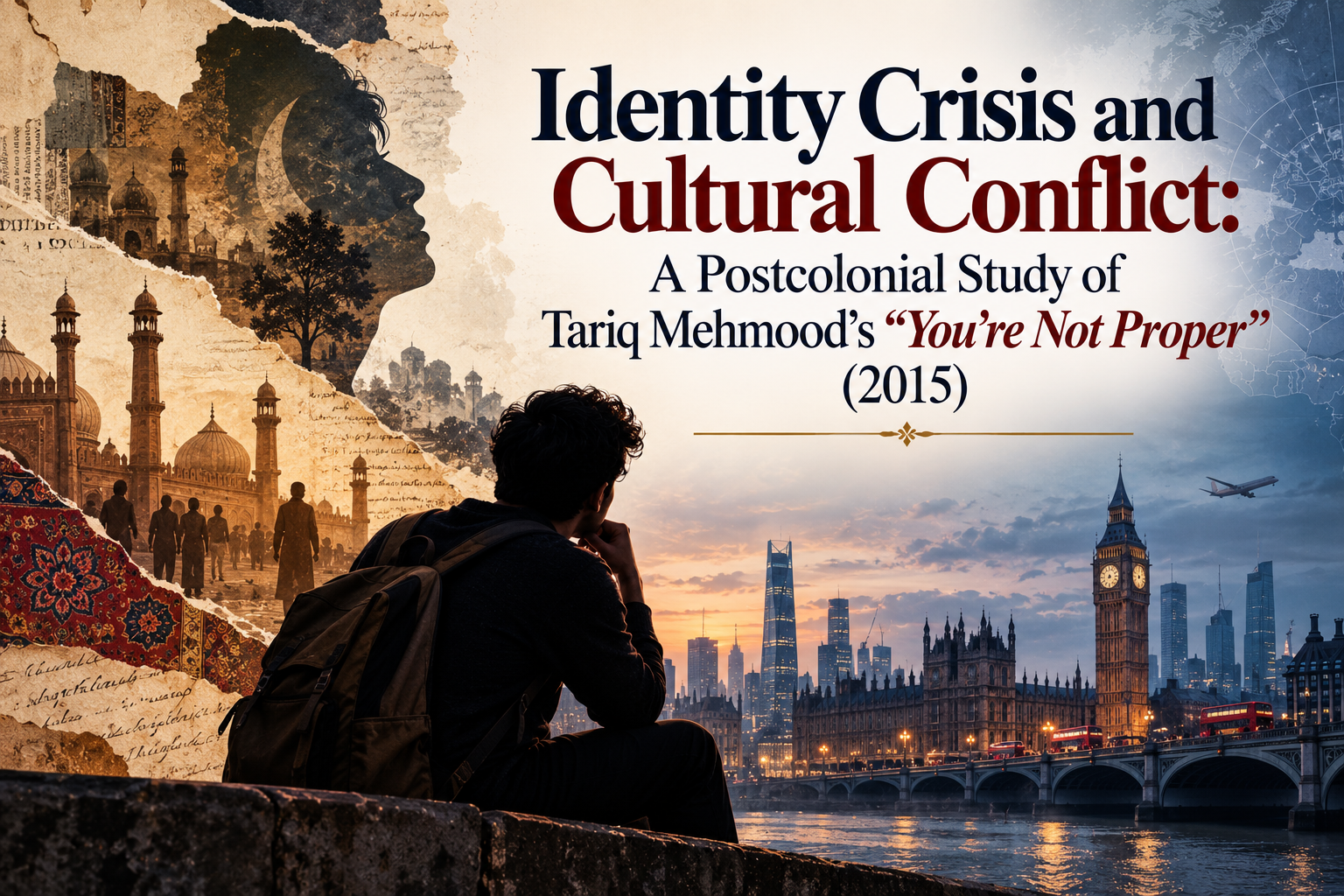
Identity Crisis and Cultural Conflict: A Postcolonial Study of Tariq Mehmood's “You're Not Proper” (2015)
DOI:
https://doi.org/10.63056/jllsa.2.11.2026.430Keywords:
Ambivalence, Cultural Conflict, Hybridity, Identity Crisis, Marginality, MimicryAbstract
Colonialism leaves profound and multidimensional effects on colonized societies and individuals, particularly in relation to cultural belonging and identity formation. This study examines the interrelationship between hybridity, identity crisis, and cultural conflict in Tariq Mehmood’s novel You’re Not Proper (2015). The novel centres on female character Kiran, whose identity is shaped by her Christian mother and Muslim father. Negotiating the religious and cultural expectations associated with these backgrounds, Kiran experiences uncertainty about her sense of self and belonging. Her predicament reflects broader tensions surrounding religious identity, cultural differences, and the negotiation of belonging within a postcolonial context. Employing qualitative textual analysis, the study investigates Kiran’s experiences, relationships, and struggles with identity formation through Homi K. Bhabha’s postcolonial concepts of hybridity, mimicry, and ambivalence. The analysis explores how her hybrid background complicates her identification with either religious community and exposes her to marginalization and conflicting expectations. It further examines the role of family, religion, and cultural norms in shaping her identity crisis and considers how ambivalence characterizes her negotiation of competing identities. The findings suggest that Mehmood presents identity as complex, fluid, and continually negotiated rather than fixed or predetermined. By foregrounding Kiran’s experiences, the study contributes to an understanding of identity formation and cultural conflict in postcolonial literature. It also provides a basis for further research into the intersections of language, culture, identity, trauma, and memory in postcolonial literary texts.
Downloads
Published
How to Cite
Issue
Section
License
Copyright (c) 2026 Aneesa Kalsoom Younis, Dr. Asma Iqbal Kayani, Muqudus Shahab, Fizza Imtiaz

This work is licensed under a Creative Commons Attribution 4.0 International License.