Parental Beliefs Linking Vaccines to Autism: A Narrative Review of Prevalence, Drivers, and Responses
DOI:
https://doi.org/10.63056/jllsa.2.11.2026.460Keywords:
vaccine hesitancy, autism spectrum disorder, parental beliefs, misinformation, health policy, PakistanAbstract
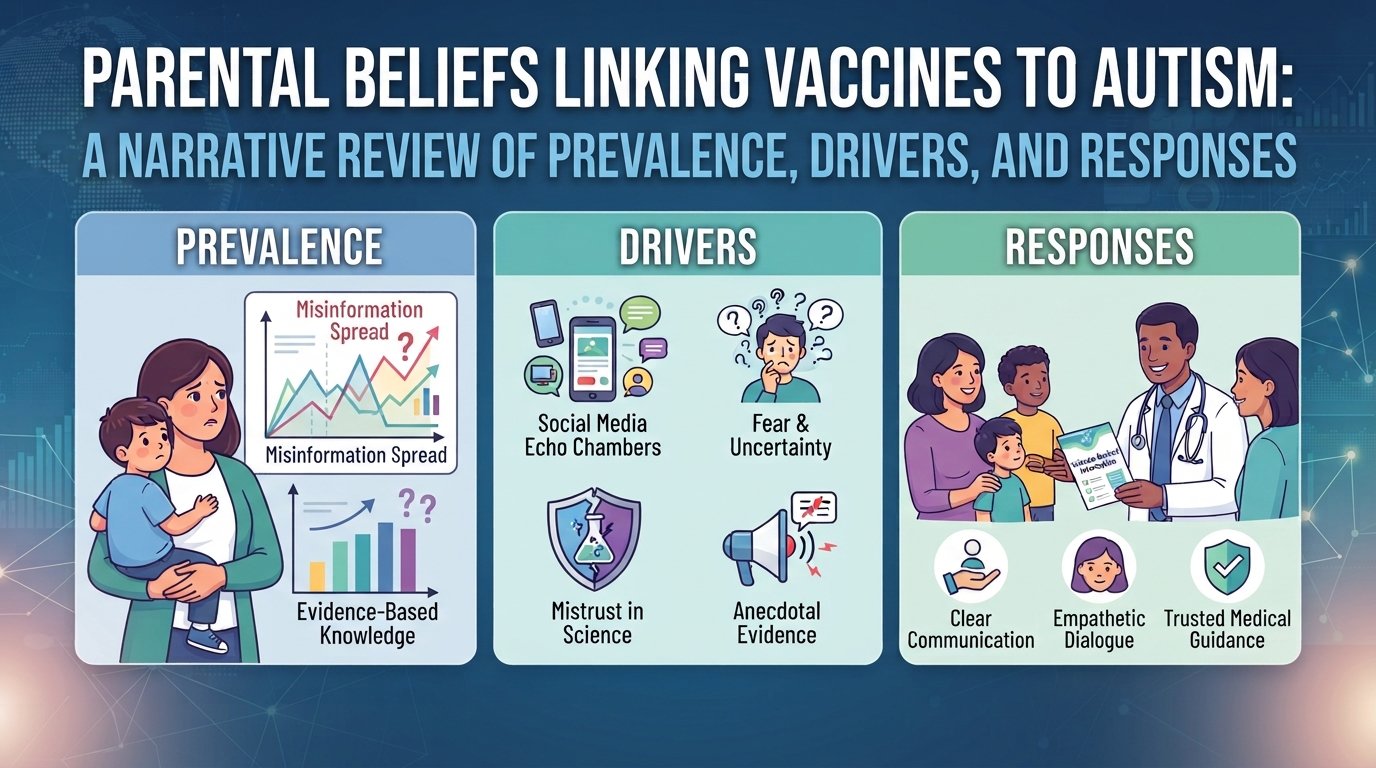
Background: Large studies show no link between childhood vaccines and autism. Yet many parents still believe in a link, and since 2025 senior U.S. officials have repeated the claim. Objective: Using the 5C model and the attitude roots account, this narrative review examined who holds the belief, what predicts it, how it affects vaccination, and what corrects it, with attention to Pakistan. Method: We searched PubMed/MEDLINE, Consensus, the Wiley Scholar Gateway, and grey literature up to November 2026 and reported the review against SANRA. Results: The belief is held by a small and uncertain minority. In 2025, 9% of U.S. parents agreed with it and about half were unsure, and Gulf studies report 10% to 27%. It is more common among parents of autistic children, whose odds of hesitancy are more than twice those of other parents, and their younger children are three times as likely to be under-vaccinated. Conspiracy thinking, reactance, overconfidence, social media use, and a child's regression predict the belief better than education. Correcting the myth lowers belief but not intention to vaccinate. Messages about disease risk, trusted providers, and presumptive communication work better. No study has measured the belief in Pakistan, where refusals center on infertility and religion. Conclusions: The belief rests on motives and experiences that facts alone do not reach. Official support for the claim may enlarge the group of unsure parents. Pakistan first needs basic prevalence data.
Downloads
Published
How to Cite
Issue
Section
License
Copyright (c) 2026 Saira Jabeen, Aiman Khan, Nimra Habib, Aqsa Iqbal

This work is licensed under a Creative Commons Attribution 4.0 International License.