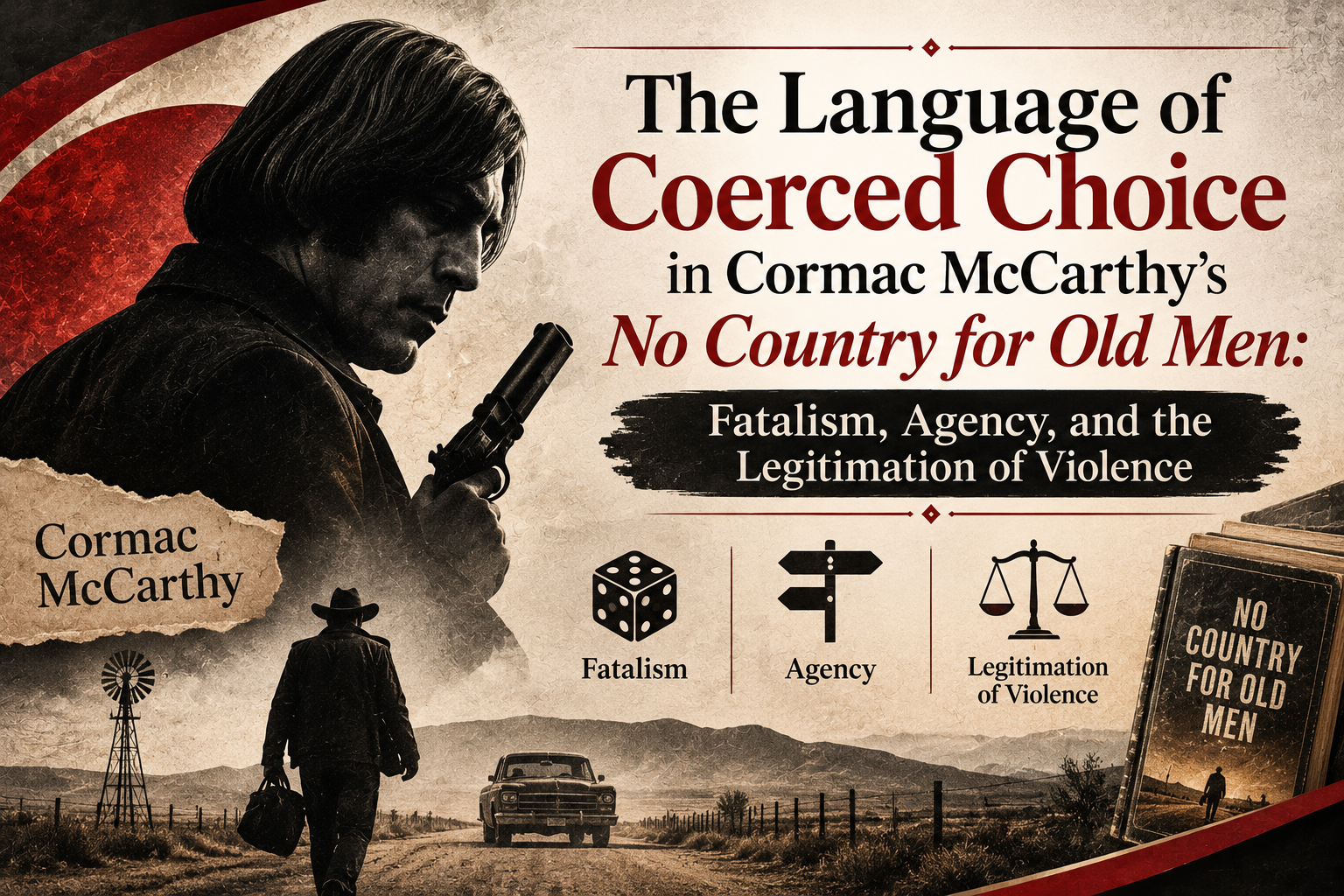
The Language of Coerced Choice in Cormac McCarthy’s No Country for Old Men: Fatalism, Agency, and the Legitimation of Violence
DOI:
https://doi.org/10.63056/jllsa.2.11.2026.466Keywords:
Cormac McCarthy, No Country for Old Men, critical stylistics, coercion, legitimation, moral responsibilityAbstract
In Cormac McCarthy’s No Country for Old Men, Anton Chigurh repeatedly asks the people he threatens to take part in explaining what is about to happen to them. This article examines how their answers enter his account of responsibility. A comparative close reading applies critical stylistics, speech-act theory and discursive legitimation to three encounters. At the gas station, Chigurh elicits a call while withholding the terms of the wager. In the hotel, he acknowledges Carson Wells’s proposal to leave and denies it any practical effect. In her bedroom, Carla Jean Moss first refuses the coin toss, then calls it, and afterwards identifies Chigurh as the person responsible. The sequence of her responses distinguishes participation under threat from permission for Chigurh to act on the result. Across the three encounters, Chigurh attributes agency to others when accounting for their predicament and invokes necessity when accounting for his own conduct. McCarthy makes the limits of that explanation audible in the voices of people who have little power over what happens next. The novel thus locates a question of moral responsibility in the difference between choosing an answer and having authority over the question one must answer.
Downloads
Published
How to Cite
Issue
Section
License
Copyright (c) 2026 Hamid Ali, Mujib Rahman

This work is licensed under a Creative Commons Attribution 4.0 International License.